YOU'RE CREEPIN MEOW: Graphics & T-Shirt Designs Review
First Look at the File Package
When I downloaded YOU'RE CREEPIN MEOW, the first thing I checked was the file organization. Too many designers send messy folders that eat up time before you even open a single asset. This one came clean. Inside, I found the promised formats — a PNG with true transparency, a SVG ready for cutting software, an editable AI and EPS for scaling and recoloring, a PDF for quick viewing, and a JPG for previews. That range covers almost every platform and production method I use across my shops, from print-on-demand marketplaces to digital download storefronts.
Opening the PNG first, I zoomed in to check the edges. For a t-shirt design asset, clean edges matter more than most sellers realize. A fuzzy outline shows up fast on a mockup, especially on dark garments. This one held up well at 300 DPI, and the transparent background was genuinely transparent — no hidden white boxes that ruin sublimation layouts. That is a practical detail I always verify before listing anything.
Mood, Personality, and Niche Appeal
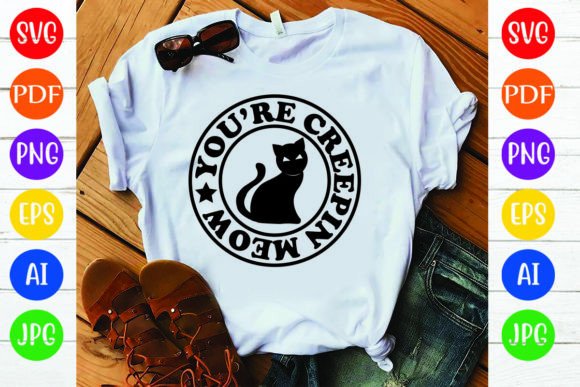
YOU'RE CREEPIN MEOW lives in that playful crossover between Halloween spookiness and cat-lover humor. The phrase itself is a pun that lands best with an audience that enjoys wordplay, pet culture, and seasonal aesthetics without taking any of it too seriously. It is not elegant or refined in the way a minimalist autumn graphic might be, and it is not trying to be. The personality here is casual, slightly cheeky, and built for impulse-buy appeal during the September-through-October window when shoppers are hunting for festive but funny pieces.
From a selling perspective, this kind of design attracts a specific buyer: someone shopping for a Halloween party shirt, a last-minute costume-adjacent outfit, a gift for a cat rescuer, or a cozy sweatshirt to wear while handing out candy. The mood is lighthearted and accessible. If your shop leans toward vintage Halloween or elegant gothic, this may feel a bit off-brand. But if you sell funny graphic tees, pet-themed merchandise, or seasonal sublimation bundles, this slots in without friction.
Testing Across Product Categories
Before I commit any graphic design asset to a live listing, I run it through a mental checklist of product types. I pulled up mockups for a standard unisex tee, a crewneck sweatshirt, a 15oz mug, and a simple tote bag. On the t-shirt and sweatshirt, the design read well at roughly 10 to 12 inches wide. The lettering stayed legible, and the overall silhouette of the graphic held together without feeling cluttered. On the mug, I scaled it down and wrapped it slightly; the curved surface did not distort the message, which is not always a given with text-heavy printable designs.
I also tested it as a digital download for crafters — specifically a sublimation design that an end buyer could press onto their own blanks. For that use case, the PNG file is the hero. I imported it into a Canva template frame to see how it would behave for customers who do not own professional design software. It dropped in cleanly, and the transparency meant no awkward white rectangle behind the graphic. That alone reduces the support messages from confused buyers, which matters when you are selling at volume.
Where YOU'RE CREEPIN MEOW Performs Best
This asset shines brightest on apparel. The scale, the typographic personality, and the seasonal punchline all translate directly to t-shirt designs, hoodies, and sweatshirts. I would also confidently place it on tote bags, throw pillows, and kitchen towels — any flat surface where the joke has room to breathe. For printable sublimation sellers, it works as a standalone transfer sheet or as part of a larger Halloween bundle.
Beyond physical products, I see strong potential in social media graphics. A pet boutique or a cat rescue could use the PNG design on an October fundraising post, a shelter adoption event flyer, or a seasonal newsletter header. The file versatility — especially the SVG and AI formats — means you can recolor it to match a brand palette or isolate elements for a design bundle without starting from scratch. That flexibility raises the long-term value beyond a single-product use.
When to Use Caution
Not every commercial design translates to every product, and ignoring those limits leads to returns and disappointed customers. With YOU'RE CREEPIN MEOW, I would avoid shrinking it down to sticker size without testing first. Some of the finer linework, depending on the file version you use, may close up when cut on a Cricut or Silhouette at small dimensions. If you plan to offer it as part of a sticker design pack, run a test cut on your specific machine and blade settings before bundling it into a listing.
I would also pause before placing it on dark backgrounds without modification. Depending on the colorway of the version you received, dark garments may swallow parts of the graphic that rely on subtle shading. Always preview the design on both a white mockup and a black mockup. If the contrast feels weak, a quick recolor in Illustrator or even a free tool like Inkscape can fix it, but you need to catch that before a customer does.
Another small note: if you sell in marketplaces that attract international buyers, remember that puns do not always cross language borders cleanly. The phrase creepin meow relies on English wordplay. It may not resonate as strongly with a non-English-speaking audience, so factor that into your keyword strategy and target market selection.
File Quality and Production Readiness
When I inspect a digital product intended for resale, I am looking for whether the files are ready to use or whether I will spend an hour cleaning them up. The SVG file here imported into Cricut Design Space with grouped layers that separated cleanly. No stray nodes, no broken paths, and the cut preview looked accurate. That matters enormously for crafters who buy SVG designs expecting a one-click experience. A bad SVG file generates complaints faster than almost anything else in a creative marketplace.
The AI and EPS files gave me full editability. I was able to change colors, adjust the composition slightly, and export at custom sizes for different product templates. If you build Canva templates or printable wall art collections, having vector source files means you can produce multiple color variations from one asset — a solid strategy for making a small design bundle feel bigger than it actually is.
The PNG resolution checked out at 300 DPI at a print size large enough to cover a standard adult t-shirt front. That is the minimum bar for print-on-demand platforms like Printful, Printify, or Monster Digital. Anything lower and you risk a pixelated print that tanks your review score.
Presenting the Design to Increase Perceived Value
A design asset is only half the equation. The way you present it in a listing determines whether someone clicks through or scrolls past. With a playful piece like YOU'RE CREEPIN MEOW, I lean into lifestyle mockups. A flat-lay image of a folded shirt does not tell the same story as a mockup showing someone at a pumpkin patch or a cozy indoor scene with a cat. Visual storytelling turns a $4 digital file into something that feels worth purchasing.
For the listing thumbnail, I tested the design against a few backgrounds. On a clean white backdrop, the graphic pops well and the pun is instantly readable even at thumbnail size — critical for Etsy product search results where you have maybe one second to catch a shopper's eye. On a textured or busy background, it lost some readability. I would keep the main listing image simple and let the additional photos show the design in context on mugs, totes, and apparel.
If I were building a seasonal collection around this asset, I would pair it with two or three complementary designs — perhaps another cat-themed Halloween graphic, a coordinating spooky phrase, and a simple decorative element that buyers could mix and match. Bundling raises the average order value and makes the shop feel curated rather than random.
Licensing and Commercial Use Considerations
Before you list any product built around a purchased graphic design asset, check the license terms. Most commercial licenses allow you to sell finished physical products like printed shirts and mugs without issue. But if you plan to resell the file itself as a digital download, or include it in a design bundle that other sellers can use, that often requires an extended commercial license. I always read the fine print twice, and I keep a folder of license documentation organized by supplier in case a marketplace ever flags a listing. It takes five minutes up front and saves potential legal headaches later.
Practical Testing Routine Before Publishing
Over the years I have developed a short but effective pre-listing routine for any new printable design asset. I run it through the following steps, and I recommend the same for YOU'RE CREEPIN MEOW:
- Preview the design on a product mockup for your primary product type — t-shirt, mug, or digital print.
- Shrink the mockup to thumbnail size and check whether the message remains readable.
- Test the design on both a white and a dark background to assess contrast.
- If offering an SVG for crafters, run a test cut on your machine to confirm cut quality.
- Open every file format to verify there are no corrupted downloads or missing elements.
- Print a small swatch at actual size on your home printer to check color accuracy against your screen.
- Organize the customer-facing files into clearly labeled folders before uploading — a small courtesy that reduces confusion and refund requests.
This routine catches most issues before a single buyer ever sees the product. It is not glamorous work, but it is the difference between a shop that earns repeat customers and one that fights chargebacks.
Font Pairing and Typography Notes
Because YOU'RE CREEPIN MEOW is built around a distinctive lettering style, I tested a few font pairings for sellers who might want to use it in a Canva template or layered social media graphic. The design itself leans playful, so a clean sans serif subheading underneath keeps things legible. A bold serif works nicely for adding a date or event name without competing with the main graphic. I would avoid pairing it with an overly decorative script font — the graphic already carries enough personality, and adding flourishes on top can make the layout feel chaotic. If you need a secondary text, keep it simple and let the design do the heavy lifting.
Who This Asset Is For
After a thorough evaluation, I would place YOU'RE CREEPIN MEOW in the toolbox of print-on-demand sellers, Etsy shop owners, Cricut crafters, sublimation designers, and digital product creators who serve a pet-loving or humor-driven audience during the Halloween season. It is not a universal bestseller that fits every niche, but within its lane — funny, feline, and festive — it delivers exactly what the buyer expects. For a seasonal shop refresh or a quick product expansion before October, this is the kind of asset that earns its spot in a collection.