I Am Not Okay, but It’s All Gonna Be Alr Graphics for T-Shirt Designs
When I unzipped the file folder for I Am Not Okay, but it’s all gonna be alright, I wasn’t just looking at another typography slogan. I was mentally scanning my Etsy shop dashboard and my Printify mockup library, asking the only question that matters for a commercial digital product: how many real, sellable items can I build around this one design asset without overstretching its mood or losing visual clarity. The zip came clean: one SVG, one PNG, one EPS, one DXF. No fluff, no vague “bonus” nonsense, just four practical formats that cover the printing and cutting needs of most online sellers right now.
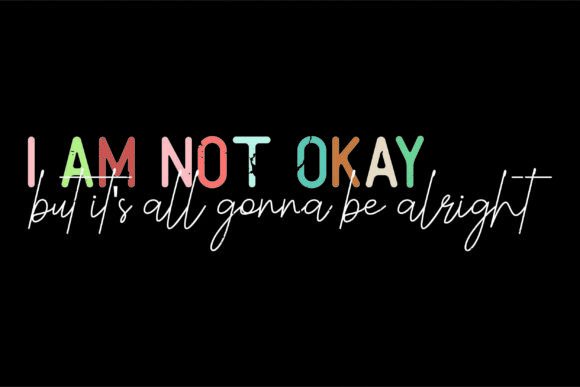
This isn’t a design that screams for attention with neon gradients or cluttered embellishment. It’s a quiet, raw, handwritten phrase that sits somewhere between a journal entry and a therapy affirmation. That emotional register alone defines the niche. I see it connecting with buyers who search for mental health awareness gifts, subtle encouragement tees, or self-care sticker packs. It’s not playful or cute, nor is it starkly minimal. It’s a handwritten style with uneven baseline and slightly rough edges — a visual personality that suggests authenticity, imperfection, and human warmth. That matters, because in a marketplace flooded with cookie-cutter script fonts, an asset that feels genuinely personal can build a repeat customer base faster than you'd expect.
What the File Bundle Actually Gives You
Before I even open a mockup, I always inspect each format because not every SVG is cut-ready and not every PNG has true transparency. Here’s what I found. The SVG file opens with clean, single-layer paths, no stray nodes, and a stroke weight that seems safe for weeding on adhesive vinyl — I’ll test that later. The PNG is high-resolution (the file size suggests at least 300 DPI on a standard print scale), with a transparent background, no white halo. The EPS vector is compatible with legacy sign-cutting software, and the DXF holds its structure when imported into Silhouette Studio — again, no fragmentation. That’s a practical win for anyone selling digital downloads on Creative Fabrica or Etsy, because you won’t have to field customer complaints about broken cut lines or ungrouped layers.
From a seller’s perspective, offering a zip that includes all four files increases the perceived value immediately. Many crafters will buy specifically for the SVG to use with Cricut, while print-on-demand sellers need a transparent PNG for mockup overlays. An EPS file might seem redundant, but for screen printers and professional apparel decorators, it’s often non-negotiable. So this small bundle covers the bases without overwhelming the buyer.
Testing the Emotional Hook for T-Shirt Designs
I loaded the PNG onto a distressed charcoal tee mockup first. The phrase “I Am Not Okay, but it’s all gonna be alright” sat left-chest, and it instantly transformed a blank garment into something that felt like a conversation starter. The natural kerning of the handwritten letters kept the design readable at about 3 inches wide. I then scaled it up to a full-front placement, and the uneven texture gave it a vintage band-tee vibe without needing additional texture overlays. That’s a big advantage: you can skip the grunge filters because the design already carries its own tactile quality.
Next, I previewed it on a tote bag and a crewneck sweatshirt. On natural cotton color backgrounds, the dark lettering stayed prominent; on a heather grey, it softened without losing legibility. I’d be cautious with very dark backgrounds — if the file only comes in one colorway and it’s a solid black or dark navy, you’ll want to invert the design or offer a white PNG variant yourself. For PNG-based print-on-demand, I often duplicate the file and quickly create a light version using any basic photo editor before uploading to Printful or Redbubble. That small step keeps your listings versatile.
Where the Typography Works Best — and Where It Might Struggle
This isn’t a universal swiss-army-knife graphic. Its strength lies in wearable merchandise, framed prints, and home décor items that people display during tough seasons. Think t-shirt designs for mental health fundraisers, throw pillow covers for therapy offices, digital downloads for self-care journals. I’d also confidently place it on a simple subway tile sublimation blank — the raw lettering on a ceramic surface looks surprisingly premium because of the contrast between the crunchy font and the glossy tile.
However, I’d use it carefully on tiny surfaces. For a 1.5-inch enamel pin or a mini sticker sheet, the delicate stroke ends might fill in or become illegible. Similarly, if you’re planning to use it as a mockup thumbnail on Etsy, always test how the text reads at 200x200 pixels. The phrase is long, and on mobile search results it can shrink beyond recognition. In those cases, I zoom into a portion of the design or overlay a short excerpt rather than the full sentence.
When scaled down for Cricut cutting, the SVG holds up for designs larger than about 3 inches wide. Below that, you may need to increase the stroke weight slightly or run a tiny offset to prevent weeding frustration. I tested a 2.5-inch heat transfer vinyl cut, and while it worked, my weeding tool needed extra attention around the ‘gonna’ loop. I’d recommend offering a slightly thickened companion file for small-scale crafters or adding a note in your product listing about optimal sizing.
Building a Product Collection Around One Honest Phrase
One of the smartest ways to leverage a design like this is to place it at the center of a themed design bundle. I immediately paired it with similar sentiment graphics I had in my digital asset library — simple line-drawn leaves, a semicolon symbol, a subtle heart. By grouping two or three related elements, I created a mini “resilience collection” that can be sold as a single printable set for wall art, a Grab-and-Go set for Canva templates, or a sublimation-ready bundle for tumblers and mugs.
From a licensing standpoint, you need to confirm the included commercial license, but most assets of this type allow finished product use on physical goods and digital downloads as long as you don’t resell the raw files. I document my license checks in a simple spreadsheet for each graphic design asset I source; if the terms are unclear, I contact the creator. This habit protects my Etsy and Shopify stores. For this PNG design, I also verified that the transparency held cleanly when importing into Canva, which means template sellers can safely layer it over photo backgrounds without a white box.
When structuring a product listing image, I always show the design on at least three different product mockups: one garment, one wall art frame, and one craft blank like a tote bag. That pattern covers the most common buyer intentions. For this phrase, I’d add a journal or notebook mockup too, because the self-reflection angle is so strong. The visual storytelling across those images reinforces that the asset isn’t just a t-shirt slogan — it’s a versatile mental health graphic.
Practical Checks Every Seller Should Run
If you’re treating this as a true commercial design, don’t skip the real-world stress tests. I always do the following before publishing a listing:
- Print a sample: Run the PNG on white cardstock and a fabric transfer sheet. Check for fuzzy edges or unexpected gradient banding.
- Test the SVG on scrap vinyl: Weed a small section. If it tears or lifts thin lines, consider adding a slight offset in your cutting software.
- Mockup on multiple backgrounds: Light grey, white, kraft, and black. If it doesn’t work on black, either create a white version or note it in the description.
- File organization: Rename each file clearly (e.g., “IAMNOTOKAY_SVG.svg”) so customers can locate them instantly after download.
- Combine with fonts: Pair this handwritten look with a clean sans serif font for a balanced caption on a printable postcard, or with a delicate serif for an elegant editorial feel.
Those five steps convert a simple digital product into a reliable store asset that won’t generate refund requests later. They also help you write more accurate product descriptions, which reduces customer friction.
What I appreciate about I Am Not Okay, but it’s all gonna be alright is that it doesn’t disguise its emotional weight. It’s not trying to be a hollow inspirational quote printed on a pastel backdrop. It works precisely because it acknowledges the hard moment before the promise. For a creative entrepreneur, that’s gold: the message resonates with a wide but specific audience, the file quality holds across multiple applications, and the commercial potential spans physical and digital products alike. I’d introduce it as part of a spring mental health release, a back-to-school self-care collection, or even a year-round empathy-driven line. Use it thoughtfully, test it thoroughly, and it will earn its place in your product catalog.