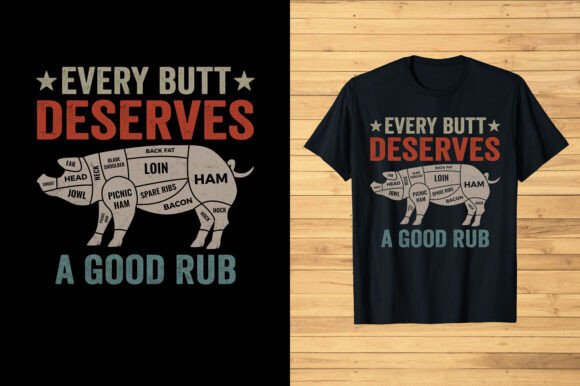
Every Butt Deserves a Good Rub BBQ Shirt
Straight talk from someone who has spent more hours than I care to count staring at stitch-outs and tearing my hair out over stabilizer choices: a design’s personality tells me everything before a single thread hits fabric. When I pulled up the Every Butt Deserves a Good Rub BBQ Shirt graphic, I wasn’t just reading text. I was already picturing the raised eyebrow from a customer at a craft fair, the laugh over a Father’s Day present, the slightly cheeky yet completely wearable merch for a local smokehouse. This design leans hard into humor and barbecue culture, and that immediate sense of belonging to a moment—grill tongs in one hand, a cold drink in the other—gives it real product legs.
Right away, the mood is playful, unpretentious, and made for people who don’t take themselves too seriously. The phrase itself is a pun that lands gently, not offensively. A good rub is both a seasoning and a massage, and that double meaning makes it giftable, conversation-starting, and surprisingly versatile. From an embroidery designer’s point of view, the challenge isn’t the joke—it’s translating that bold personality into stitches without losing clarity or durability.
How the Visual Personality Translates to an Embroidery Project
Even though this is a T-Shirt Designs graphic in the Graphics category, I evaluate it for what it will become after digitizing. The layout feels natural for a left-chest placement or a centered back on a tee. The lettering likely carries the weight—thick enough to show up well in satin stitch, but you have to watch the small connecting spaces. In a pure print, those tiny gaps are negligible; in embroidery, they can close up if you aren’t careful with your stitch angle or pull compensation. So my first reaction: this design wants to be a crisp, high-contrast appliqué text or a bold fill-stitch statement on a solid background.
It doesn’t scream for elaborate detail, which is a good thing. Embroidery hates overly complex, tiny elements that turn into thread mud. The power here is the phrase and maybe a subtle curling font or a mini meat-cut illustration—if the file includes that. Checking the actual artwork is key, but from the description, I expect a clean, readable wordmark. That gives me freedom. A simpler design means I can scale it up for a tote bag without worrying about thin strokes crumbling, or scale it down for a cap as long as I keep the smallest letters above a quarter-inch.
Where I’d Use It Without a Second Thought
Let’s be practical. Over the years, I’ve ruined enough blanks to know when a design and a product are natural partners. The Every Butt Deserves a Good Rub BBQ Shirt graphic feels right at home on kitchen textiles. I’d immediately test a stitch-out on a flour-sack tea towel with a dense cotton weave. The texture of the fabric complements the homey, rustic humor. An apron becomes a no-brainer: center the design on the bib, add a subtle smoke-ring outline, and you’ve got a Father’s Day gift that gets used every weekend.
For apparel, a heavyweight cotton tee or a raglan-sleeve baseball shirt in heather gray gives that vintage BBQ joint vibe. I’d avoid thin, tissue-weight shirts because the satin stitches on larger letters could drag and pucker. Tote bags? Absolutely. Canvas holds stitches beautifully, and a tote bag with this phrase walking through a farmers’ market is free advertising for a small shop. I’ve also mentally placed it on a denim jacket back panel, where the texture contrasts nicely with a thick fill stitch. Caps are trickier because of the seam down the front, but if you split the lettering into two lines and keep the height around 2 inches, it can wrap a structured cap without distorting.
The Unexpected Merch Winner: Embroidered Patches
If I were running an Etsy shop or prepping for a craft fair, I’d digitize this as an embroidered patch. Patches solve so many friction points: customers can iron them or sew them onto their own items, you don’t have to stock multiple garment sizes, and the perceived value is high. A 3-inch patch with a merrowed edge and the phrase in a sturdy fill stitch would sell well to BBQ enthusiasts who want to customize their grilling apron or cooler bag. Since the design’s humor is universal enough, the patch would also appeal to people looking for a funny gift for a friend who is “the grill master.”
When the Design Needs Extra Care
Nothing is perfect. Certain situations will test this design more than others. Small hoop sizes below 4x4 inches could force the lettering to shrink below my comfort zone, especially if the original includes a graphic element like a pig silhouette or grill marks. On stretchy performance wear, the threads won’t give the way the fabric does, so you’d need a heavy-duty cutaway stabilizer and even then, I’d proceed with caution. Thin, silky fabrics? Not the intended home. Dark fabrics are fine with proper backing, but if the thread colors are dark too (say, charcoal on black), you lose legibility from more than arm’s length.
Layered garments, like a hoodie with a front pocket, force you to either hoop only one layer and risk the pocket shifting or avoid that placement entirely. I’ll also mention washing: the phrase contains a tongue-in-cheek double meaning, but customers won’t laugh if the threads loosen after three cycles. A well-digitized file with appropriate underlay stitching solves this, but you as the maker need to test that. Always, always run a wash test on one finished piece before sending anything to a client.
The Emotional and Commercial Pull
Here’s the part a lot of technical reviews skip. Buyers connect to inside jokes that feel personal. The Every Butt Deserves a Good Rub BBQ Shirt design triggers that knowing smile. When someone sees it on a handmade product—whether a pillow cover, a grilling apron, or a baby onesie at a barbecue shower—it communicates membership in a fun, food-loving tribe. That ups the giftability factor enormously. A customer purchasing a personalized gift wants to feel clever for picking it. This phrase delivers that.
For small business owners, the design’s personality directly impacts brand consistency. If your shop leans into humorous kitchen goods, this fits like a glove. If you’re a more serious, minimalist brand, it could feel out of place. But for the right audience, it builds instant buyer engagement. I’ve seen phrases like this become best-selling items at pop-up markets simply because they make people stop and chuckle. That pause leads to a conversation, and conversations lead to sales.
Practical Embroidery Designer Notes Before You Stitch
- Digitizing is non-negotiable. This product provides AI, EPS, and PNG files—perfect for print, but for machine embroidery, you must convert it into an embroidery file (like .PES, .DST) with appropriate stitch types. Hire a professional digitizer or do it yourself if you have the software.
- Test on a similar weight scrap fabric first. What looks good on screen can crown in satin, especially on curved letters. A quick sew-out saves heartache.
- Check thread color contrast. Off-white thread on a cream tote bag may read as dirty instead of deliberate. Pull test threads in different light.
- Review stitch density. Too dense on a softer base fabric like fleece can cause tunneling. Ask your digitizer to adjust for the material you’re targeting.
- Confirm hoop size. Don’t guess. Measure the actual digitized design after conversion and ensure your machine can handle it.
- Inspect small details. If the lettering has delicate serifs or thin connectors, they might need simplification for clean embroidery.
- Mock it up in black and white. If the design’s impact relies on color, you’ll want to know how it reads on a monochrome stitched version for customers who request a minimal look.
- Compare light and dark fabric backgrounds. Embroidery thread can look dramatically different on a black canvas versus a white one. Test both.
- Use the right stabilizer. For stable woven fabrics, a tear-away is often enough; for knits, cutaway; for towels or fleece, a water-soluble topper prevents stitches from sinking in.
- Check licensing before selling finished items. Since the product description lists “You can use it for creating products such as T-Shirts Mugs Pillow Other Print items,” it appears to allow physical finished goods, but always verify directly with the seller if you plan to sell commercially, and understand the difference between printed items and embroidered items if the license is ambiguous.
- Run a final finished product through a laundry cycle. Even with the best techniques, you won’t truly know durability until real life hits it. Your reputation is on the line.
What I’d Make First for a Real Project
If I were opening a custom order this week and a client came to me wanting something for a milestone birthday BBQ party, I’d pick a heavy-duty canvas apron in a warm natural tone. I’d digitize the Every Butt Deserves a Good Rub BBQ Shirt text as a single satin-stitch line with a little shadow effect beneath it (done with a second layer of stitching in a darker thread). I’d add the guest of honor’s name in a smaller running stitch near the bottom, and present the apron rolled with a custom tag. That’s a $45–$55 product that feels handmade, looks polished, and earns a permanent spot in someone’s grilling routine.
For a lower-priced impulse item, my patch idea wins. A 3-inch round or shield-shaped patch with the phrase arched inside a border, backed with heat-seal, would fly off the rack at a craft market. I’d list it online as a “funny BBQ patch for jackets, hats, and bags,” and mention it’s ideal for Father’s Day, birthdays, or groomsmen gifts.
Final Thoughts on a Smile-Inducing Asset
The Every Butt Deserves a Good Rub BBQ Shirt graphic isn’t trying to be elegant or subtle, and that’s precisely its strength. It’s a conversation piece waiting to become a handmade product. What I appreciate most as a reviewer is that the design’s potential doesn’t stop at T-shirts. A creative maker can translate this into embroidery projects that feel thoughtful and intentional—far beyond a generic gift. The key is respecting the transition from print to stitch. If you digitize with care, select the right foundation, and test everything, your finished product won’t just get a laugh—it’ll become someone’s favorite item to wear while they flip ribs. And honestly, that’s the kind of practical, memorable result we’re all after in this line of work.