30 Detailed Sea Creatures Marine: Graphics & T-Shirt Designs
The first time I opened the 30 Detailed Sea Creatures Marine bundle, I was immediately transported to a windswept coastline. There’s a quiet authority in these engravings — the kind that feels pulled from a 19th-century naturalist’s journal, yet somehow perfectly at home on a modern streetwear mockup. The collection carries a salt-crusted authenticity that’s rare in today’s ocean of overly polished clipart. For a designer like me, who often builds visual identities for handmade businesses and boutique brands, this asset triggered a dozen client ideas before I even zoomed in to inspect the linework.
A Visual Mood That Commands Quiet Attention
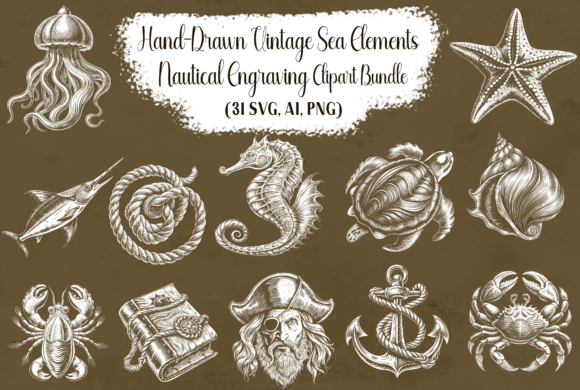
The style sits squarely in the vintage nautical engraving tradition — think scrimshaw, ship logs, and museum archive prints. Each creature, from the coiled octopus tentacle to the spiny lobster and the intricate chambered nautilus, is rendered with dense, deliberate hatching. The Vintage Nautical Engraving Bundle 30 Detailed Sea Creatures Marine Elements avoids the common pitfall of looking like a rushed digital trace; the lines retain a hand-hewn texture that lends weight to any layout. This isn’t just decoration. It’s a storytelling tool. I could immediately picture it anchoring a brand identity for a small-batch oyster farm, an artisanal rum label, or a coastal lifestyle apparel line.
What struck me most was the emotional resonance. The imagery evokes patience, craftsmanship, and a connection to the sea that feels timeless rather than trendy. That’s gold for clients who need to signal heritage, quality, or an eco-conscious ethos without saying a word. The mood is brooding enough for a literary fiction book cover, yet playful enough for a children’s oceanography camp t-shirt. That range makes it a genuine workhorse for a designer juggling multiple project briefs.
Where the Detailed Sea Creatures Shine in a Real Client Project
In my current workflow, I’m designing a full visual package for a small coastal café launching a line of organic cotton apparel. They needed something that felt simultaneously rugged and refined — exactly what this graphic design asset delivers. For the hero t-shirt print, I placed the humpback whale engraving across the back, and it needed almost no adjustment to feel fully resolved. The density of the line art creates natural texture that holds its own against a plain fabric ground, working beautifully as a standalone statement graphic.
On packaging, I scaled one of the crab illustrations down to accent the corner of a kraft paper label. The detail held remarkably well even at two inches wide, retaining its visual punch. I’ve also seen this bundle used in social media graphics where the marine elements act as framing devices — a delicate seahorse silhouette bordering a quote card, for instance. In every scenario, the graphics lifted the design from generic to intentional. They bring a sense of place that’s hard to achieve with standard iconography.
The Practical Edge: File Formats and Real Design Flexibility
Let’s talk about what’s under the hood. This T-Shirt Designs bundle includes SVG, PNG, and AI formats — and that matters enormously for a commercial design environment. I tested the vector files in Adobe Illustrator and found them well-organized: clean paths, minimal stray points, and no nested clipping masks that break when you resize. For apparel mockups, I could scale the octopus graphic to 18 inches wide without any loss of fidelity, then easily change the stroke weight to suit a discharge ink printing technique. That kind of editability is essential for print-on-demand sellers and studios doing custom client apparel.
The transparent PNGs saved me in a time crunch. When a client needed a last-minute addition to their homepage banner, I dragged the jellyfish directly into a Photoshop mockup and got an instant layered effect without masking. The 300 DPI resolution held sharpness on a 4K screen, which is more than I can say for many other clipart packs I’ve tested. If your workflow leans on Canva or Cricut, these assets slot in seamlessly — you can upload the SVGs, resize, and maintain that intricate engraved look without the design breaking apart.
Where Caution Pays Off in Client Work
No asset is universally perfect, and there are a few situations where I’d use these marine elements with a steady hand. First, very small applications — think tiny embroidery on a polo shirt or a quarter-inch web icon. The fine hatching can turn muddy or vanish entirely. I tested the knobbed starfish at half an inch, and while the silhouette remained recognizable, the internal linework became visual noise. In those cases, I’d simplify the graphic, which requires manual editing skills, or choose a different whale from the set with a bolder contour.
Second, minimalist corporate branding that relies on flat, geometric shapes and abundant white space will likely clash with this densely illustrated style. I once tried pairing the shrimp engraving with a modern sans-serif tech logo, and the contrast felt jarring rather than clever. The assets thrive in analog, eclectic, and richly textured brand worlds — rustic food packaging, editorial magazine spreads, board game art, or nature-center signage. They also demand generous layout space. Crammed into a busy festival flyer alongside neon text and photo cutouts, the delicate linework disappears. Give them room to breathe, and they’ll reward you.
Readability, Hierarchy, and the Vintage Engraving Advantage
One thing I always check is how a graphic interacts with typography. I placed the sea turtle beneath a serif masthead, a bold sans serif callout, and a flowing script tagline. The result? The graphic paired beautifully with Garamond and Caslon, enhancing the historic, editorial feel. With a heavy condensed sans like Bebas Neue, the contrast was crisp and modern. Handwritten fonts needed a bit more care — a sketchy brush script sometimes competed with the engraved hatching — but a cleaner, monoline script looked elegant. This adaptability means the 30 Detailed Sea Creatures Marine graphics can slide into everything from beer label design to a Pinterest-ready blog header without forcing you to rebuild your entire type system.
From a hierarchy standpoint, these illustrations naturally draw the eye without screaming for attention. I’ve used them as a secondary storytelling layer behind a bold product shot, and they recede just enough to add atmosphere without pulling focus. That balance is critical for marketing visuals where the product or the message must remain king. The emotional appeal is strong: customers associate the engraved style with craftsmanship and authenticity, which builds visual trust for a brand that’s still establishing its presence.
Testing the Asset Before You Commit to a Client Deadline
Before I ever use a design bundle in paid client work, I run a series of sanity checks. I printed the lobster at actual size on a matte postcard and was relieved to see zero pixelation and deep, even ink coverage — no washed-out gray patches that sometimes plague low-quality vector conversions. I also tested the graphic on a dark navy t-shirt mockup by inverting the artwork to white, and the engraving strokes retained their character without looking like a negative ghost image. That’s a huge win for sublimation design and screen printing across varied garment colors.
Black-and-white performance matters especially for print-on-demand, and these graphics pass that test with distinction. I previewed them in a grayscale color mode, and the contrast ratio stayed strong, allowing them to work in one-color risograph prints or embossed stationery. Always check the license terms, of course. For any commercial design involving physical products for sale, ensure you have the correct usage rights — I confirmed that this bundle allows use in merchandise and printed goods, which cleared the path for my café client’s apparel line.
Another designer’s note: if you’re building Canva templates for an Etsy product or a digital marketplace, these marine elements give your designs a sharp, cohesive look that sets them apart from the generic watercolor whales flooding the platform. I’ve seen creators combine three or four creatures into a seamless pattern for wrapping paper or fabric, and the result is a premium, curated collection feel. The SVG design editability means you can recolor the art to match a brand palette — I shifted the octopus from black to a muted teal for a candle label and it looked like it had always been that way.
Where This Bundle Sits in Your Creative Toolkit
I think of the 30 Detailed Sea Creatures Marine graphics as a secret weapon for projects that need a dose of story and soul. It’s not a catch-all asset; you wouldn’t reach for it when designing a tech startup’s app UI or a sterile medical brochure. But the moment a brief hints at the ocean, coastal heritage, literature, old-world exploration, or artisanal production, this bundle becomes the most valuable file on my hard drive. It instantly cuts down my concepting time, because the visuals arrive with a built-in narrative that I can amplify with color, layout, and texture.
For small business owners designing their own brand, these elements offer a shortcut to a cohesive aesthetic. You can unify a product line — a candle, a soap package, a tote bag, and an Instagram post — with one carefully placed narwhal or a scattering of starfish, and suddenly everything feels intentional. That’s the power of a well-chosen graphic design asset: it elevates a side hustle into something that commands a higher price point and leaves a lasting impression on customers. After two weeks of working the sea creatures into mockup after mockup, I firmly believe this bundle earns its place as a permanent member of any designer’s nautical arsenal.